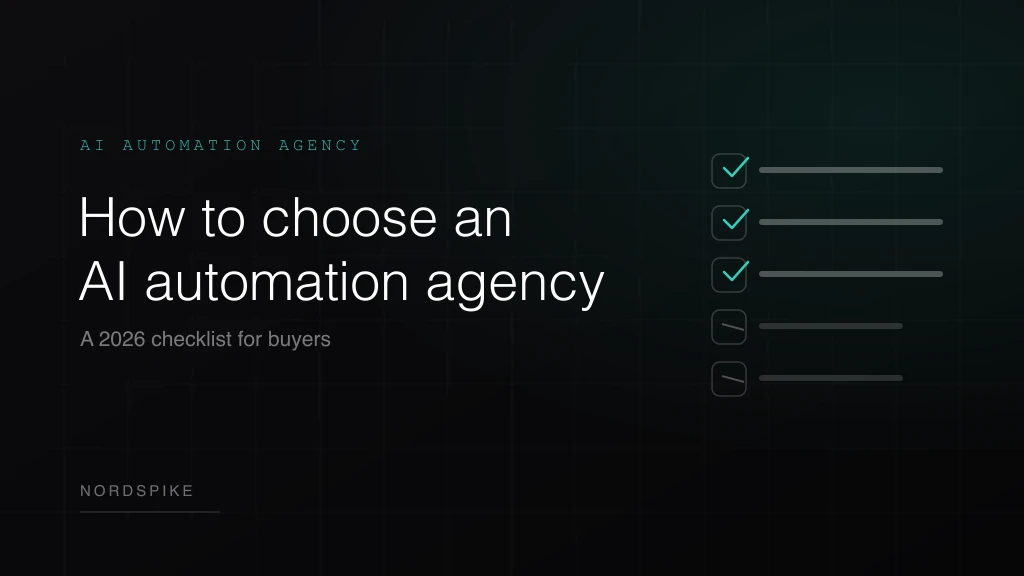
The hard part of hiring an AI automation agency is not finding one — it is telling the engineering teams apart from the resellers wrapping a generic tool in a markup. Five criteria do most of the filtering: real proof, clear fixed scope, code and account ownership, data and EU compliance, and a documented handover. Below is the checklist, the red flags, and the exact questions to ask.
The five-point checklist
Red flags
- No fixed scope. Open-ended hourly billing with no defined deliverable is how budgets quietly triple.
- Black-box delivery. If you can’t see how it works or where it runs, you can’t maintain it — and you can’t leave.
- They keep the keys. Build lives on their accounts, their infra, their API keys. That is leverage over you, not a service.
- All demo, no handover. A flashy prototype with no plan for who owns it in 90 days decays in 90 days.
Agency vs freelancer vs in-house
| Freelancer | Agency | In-house | |
|---|---|---|---|
| Best for | One well-defined automation | 3–5 automations, business-critical | Continuous, evolving AI roadmap |
| Speed to live | Fast, if they’re free | Fast, with a team behind it | Slow (hire + ramp) |
| If it breaks | Single point of failure | Team coverage + accountability | You own the fix |
| 12-month cost | € low, variable | €15k–40k (3–5 systems) | €65k–90k+ per senior hire |
Many companies start with an agency to ship the first systems fast, then bring maintenance in-house as their AI maturity grows. That hybrid is covered in build vs buy framework.
How we work
For what it is worth, this is the standard we hold ourselves to: fixed scope and price agreed up front, the code and accounts handed to you, your data kept under EU law, and a documented handover so your team is never dependent on us. If we are not the right fit, we will tell you on the first call — see how engagements run on the AI Automations and AI Development Partnership pages.