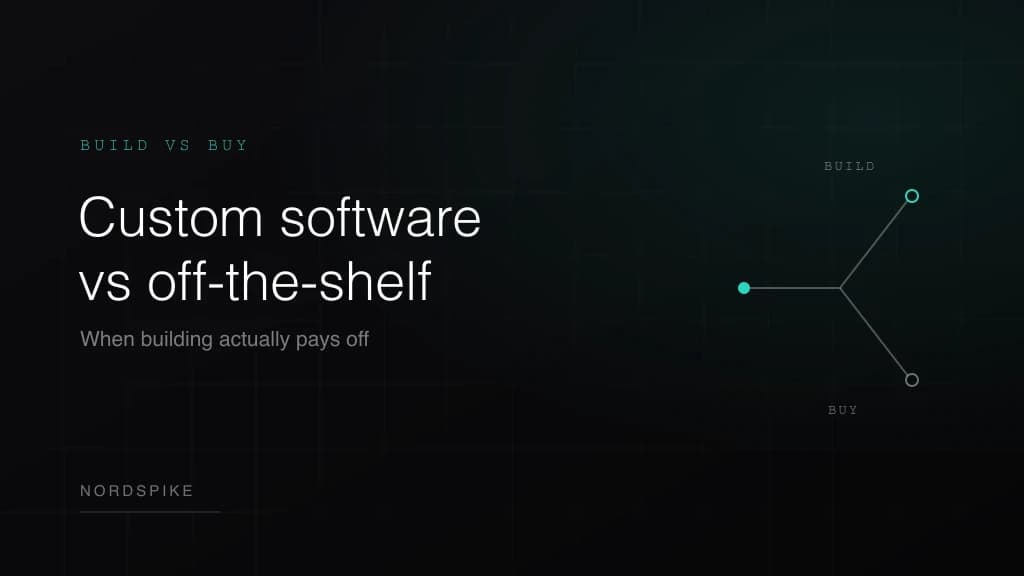
Buy off-the-shelf when the software is a commodity. Build custom when the software is your process. That one line resolves most build-vs-buy debates, but the cost of getting it wrong runs in both directions, so it is worth ten minutes. Below: the real (often hidden) cost of off-the-shelf, the signals that say build, the signals that say stay, the AI automation decision, the hybrid path that fits most companies, and what a done-for-you engagement looks like end to end.
The decision in one picture
The hidden cost of off-the-shelf
Off-the-shelf is not “cheap”. It is cheap to start. The costs show up later and rarely appear on the invoice:
- Per-seat creep. €40/user/month feels trivial at five seats. At fifty, across three tools, it is a five-figure annual line that only grows.
- Workflow compromise. You bend your process to fit the tool. Multiply a daily 10-minute workaround across a team and it is a salary's worth of wasted time a year.
- Integration tax. Tools that do not talk to each other force copy-paste, double entry, and reconciliation. The exact work software was supposed to remove.
- Data lock-in. Your process and customer data live inside someone else's roadmap and pricing. Price hikes and deprecations are not your decision.
- AI subscription stacking. Each AI agent or automation tool charges its own monthly fee. Three AI tools at €200/month each is €7 200/year for features a single custom build could consolidate.
When custom software wins
- The workflow is your edge. How you quote, route, fulfil, or report is part of why customers choose you.
- You are stitching together 3+ tools and a pile of spreadsheets to run one process.
- Off-the-shelf can do 70% and the missing 30% is exactly the part that matters.
- You have proprietary data or AI logic that no generic tool will ever model.
When AI automation wins
The same logic applies, with a narrower trigger. AI automation wins when the task is repetitive, rule-bound, and consumes human hours that could be spent on higher-value work. Common candidates:
- Lead qualification and triage. AI agents that qualify inbound leads and route them to the right team, operating 24/7 without a receptionist.
- Document processing and reporting. Extracting structured data from invoices, contracts, or emails and piping it into your CRM or dashboard.
- Customer support triage. AI answering common questions, escalating only the edge cases to your team.
- Internal operations. Scheduling, status updates, inventory checks, or compliance checks that currently rely on manual spreadsheets.
For most Estonian service businesses, the first AI automation pays for itself in 2-4 months. The second and third compound because they share the same infrastructure.
When to stay off-the-shelf
If the need is a commodity, buy it. Email, accounting, payroll, document signing, basic CRM. There is no advantage in rebuilding solved problems, and you will spend forever maintaining something a €30/month tool does better. Custom is a scalpel, not a default.
The same holds for AI automation. If a ready-made tool solves your use case out of the box, use it. Do not build a custom AI agent for something a €50/month SaaS product handles. Build only when the off-the-shelf AI tool cannot access your data, cannot integrate with your stack, or cannot handle your specific workflow.
The hybrid path most companies should take
You rarely have to choose all-or-nothing. The pragmatic path: keep off-the-shelf for commodity functions, and build a thin custom layer over their APIs for the part that is actually yours. The dashboard, the routing logic, the customer portal, the AI decision layer. You get speed and low cost where it does not matter, and control where it does.
For AI automation specifically, the hybrid means an agency builds and deploys the first 3-5 automations with full documentation and source code handover. Your existing technical team handles ongoing maintenance and minor tweaks. The agency returns quarterly for new builds and architecture reviews. This is what most Nordic and Estonian companies end up choosing after running the numbers.
Build vs buy for AI automation: the decision tree
Five questions, in order. Stop at the first “no”.
- Do you already have an experienced engineer with LLM experience on payroll? No → hire an agency. Yes → continue.
- Do you have a 12-month roadmap of 10+ automations? No → hire an agency. Yes → continue.
- Does that engineer have at least 50% of their time free for AI work? No → hire an agency. Yes → continue.
- Is AI automation becoming a competitive differentiator in your market? No → hybrid: agency builds the first 3-5, your team takes over. Yes → continue.
- Are you prepared to absorb 6-12 months of ramp-up before the first automation delivers? No → hybrid. Yes → build in-house.
Service businesses that pass all five questions are rare. Most should hire an agency or take the hybrid path. That is an honest answer. We earn less saying it, but it is the right one.
What a done-for-you engagement looks like
When you engage Nordspike for a custom software or AI automation build, the engagement follows a repeatable structure that eliminates the risk of open-ended consulting:
Phase 1: Discovery and audit (week 1-2)
- We map your current tool stack, identify every manual workflow that should be automated, and flag where off-the-shelf tools are costing you more than they save.
- We deliver a prioritised roadmap with estimated ROI for each build, ranked by effort-to-impact.
- You decide which 1-3 items to build first. No scope creep, no ambiguous deliverables.
Phase 2: Build and deploy (week 3-10)
- We architect and build the software or AI automation. For AI automations, we handle: prompt engineering, model selection, error handling, monitoring, and fallback logic.
- For custom platforms, we handle: database design, API integrations, front-end, authentication, and deployment infrastructure.
- Each deliverable is tested against real workflows before handover. You see working software within weeks, not months.
Phase 3: Handover and maintenance (week 10-12)
- Deliverables include: full documented source code, architecture diagrams, runbooks for monitoring and incident response, and a live knowledge transfer session with your team.
- Everything you need to operate independently. No lock-in, no proprietary platforms, no ongoing obligation.
- Optional light-touch retainer: €1 500-4 000/month for monitoring, minor tweaks, and quarterly roadmap reviews.
A complete 3-5 automation build across all three phases typically runs 20 000-50 000 €. A full custom software platform starts at 30 000-80 000 €. Compare that to hiring an in-house engineer at 80 000-150 000 €/year plus tooling, or stitching together SaaS subscriptions that cost 30 000-60 000 €/year at scale. The done-for-you model delivers results faster, at lower risk, with no hiring overhead.
Why Estonian companies choose this route
Estonian service businesses face a specific set of constraints that make the done-for-you model particularly effective. The local talent market for AI engineers is thin, hiring senior developers takes 3-6 months, and the total cost of a local hire (salary, taxes, benefits, tooling, onboarding) lands between 80 000 and 150 000 € per year. For a company that needs 3-5 automations or one internal platform, that math does not work.
A focused agency engagement delivers the same output in 60-90 days at roughly a third of the first-year in-house cost, with no long-term commitment and full ownership of everything built. That is why Estonian firms in logistics, professional services, e-commerce, and B2B services increasingly choose the done-for-you path over building internal teams for what is often a 12-18 month need.
Not sure which bucket you are in?
When the decision is build, the next question is scope: which slice of the process actually needs custom logic, and which parts stay on standard tools. That boundary is where the budget lives.