Every week, a service business owner sits down with a pile of invoices and turns forty minutes into data entry. The invoices came in by email, through a scanning app, or attached to a text message from a supplier who still runs paper. Each one has to be read, typed into the accounting system, checked against a purchase order, routed to someone for approval, and filed. Then next week the same pile grows back.
This year, that routine has a deadline. France begins its mandatory B2B e-invoicing rollout in September 2026. Germany already requires domestic businesses to receive structured e-invoices, with sending obligations expanding through 2028. The EU's ViDA framework is standardising e-invoicing and digital reporting across the whole union by the end of the decade. The paper-based back office is about to hit a regulatory wall, and the decision you were going to make anyway now has a date on it.
The good news is that compliance and profit point the same way. The businesses that treat e-invoicing as a back-office automation project get paid back for the digitization. The ones that treat it as a formality eat the cost of both worlds: manual labour today and software fees tomorrow.
The Hidden Cost of a Manual Invoice
The cheapest invoice you process is still more expensive than you think, because almost all of the cost is invisible labour.
Industry benchmarks put the fully loaded cost of processing one manual invoice between €8 and €15. That number includes the salary time of whoever opens the email, whoever types the numbers in, whoever approves, whoever corrects the mistakes, and whoever chases the supplier when a payment is disputed. The invoice itself is a piece of paper with numbers on it. The cost is the chain of people it has to pass through.
That chain is slow. A single invoice takes 10 to 30 minutes of human time spread across the people who touch it, and an average approval cycle runs five to seven days. It is also error prone. Studies of manual accounts payable consistently find that around 39 percent of manually processed invoices contain at least one error, from a wrong account code to a duplicated payment.
The cost is hidden because it is spread out. Nobody sees a single big line item called invoice handling on the P&L. It is buried in the salary of a person who spends a day and a half a week on data entry, in the late-payment fees from a missed due date, in the duplicate payment nobody caught, in the supplier discount lost because the invoice sat in an inbox for six days. Only 8 percent of accounts payable teams are fully automated in 2026. The other 92 percent are paying the hidden cost, every single month.
The Mandate Is the Catalyst
France starts September 2026. Germany is mid-rollout. The EU-wide ViDA standard is coming. You will digitize either way.
The French e-invoicing mandate is the one with the near-term calendar. The first phase starts in September 2026 for large companies, with smaller businesses required to follow over the following year. If you sell to French customers, or buy from French suppliers, you are going to receive and send structured electronic invoices on a defined timeline. Germany is further along: receiving e-invoices is already mandatory for domestic B2B, and the sending obligations are phasing in through 2028.
Behind both sits ViDA, the EU's “VAT in the Digital Age” framework, which will standardise e-invoicing and digital reporting across all member states. The direction is unambiguous. In the next four years, paper invoices, PDFs attached to emails, and Excel-based bookkeeping are all becoming legally insufficient for a growing share of European trade.
You are going to pay for digitization either way. The only open question is whether it becomes a cost of compliance or an investment that returns more than it costs. That is decided by whether you automate the whole process or just change the file format.
Here is the trap. A business that only buys e-invoicing software to satisfy the mandate keeps its manual workflow and adds a new fee on top. A business that automates the processing layer removes the labour cost at the same time. The first pays for compliance. The second gets paid for it.
What AI Invoice Processing Actually Does
Read, validate, code, route, post. The five steps of accounts payable, run in seconds instead of days.
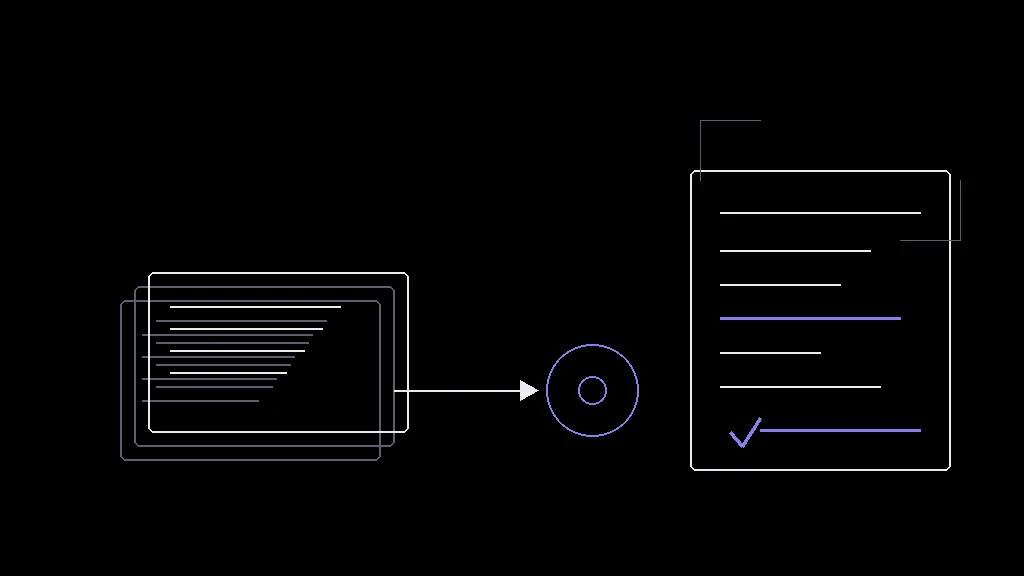
The pipeline is simpler than the acronyms suggest. First, capture. Every invoice lands in one place: email inbox, supplier portal, scanned document, whatever your suppliers send. Second, read. The AI extracts line items, quantities, unit prices, VAT amounts, due dates, supplier VAT numbers and invoice references, even from scanned documents and multi-page PDFs with attachments. Modern extraction models hit roughly 99 percent accuracy on structured fields.
Third, validate. The system checks the invoice against the purchase order or contract, flags mismatches in price or quantity, and catches duplicates before they become double payments. Fourth, code and route. The invoice is assigned to the right expense accounts and sent to the right person for approval, with the supplier history, contract and past payments attached. Fifth, post. The approved invoice flows into your accounting system through its API, and the archive is searchable forever.
The part that matters most in practice is exception handling. The goal is not to eliminate humans, it is to eliminate routine. An automated process lets 95 percent of invoices pass through without a single pair of hands, then routes the remaining 5 percent, the unusual ones, to a person with all the context attached. That is where the accuracy comes from. The AI does not guess. It reads, it validates, and when it is not sure, it asks.
The Math for a Small Business
Two hundred invoices a month is a full day of someone's week, every week, all year.
Run the numbers for a typical EU service business receiving 200 invoices a month. At 15 minutes of human time per invoice across data entry, review and approval, that is 50 hours a month, roughly 12 percent of a full-time employee, just on invoice handling. At a fully loaded cost of €25 an hour, that is €1,250 a month or €15,000 a year before a single error, late fee or duplicate payment is counted.
With automation, that €15,000 a year of labour collapses to a few hundred euros of monthly processing volume, plus thirty minutes a day of exception handling. The same 200 invoices take seconds to read and validate. Approval becomes a tap on the phone instead of a forwarded email chain. For a typical SME the system pays for itself in three to six months, and every year after that is profit. That is not a projection. That is the arithmetic of removing 50 hours of routine work from a month.
Why the Software Alone Is Not Enough
A SaaS tool processes documents. A deployment processes your business: your suppliers, your approval chain, your accounting stack.
Invoice automation software exists in plenty. The gap is almost never the extraction model. It is the integration. Your suppliers do not all send clean PDFs. Your approval chain has people who need to see invoices in their own language and their own tool. Your accounting setup has quirks, multiple entities, VAT treatments specific to Estonia, Sweden or Finland, and a chart of accounts that nobody outside the business fully understands.
That is the difference between buying software and deploying a process. An agency builds the pipeline around your actual operation, connects it to your existing accounting system without forcing a migration, trains the extraction on your real invoice formats, and handles the exceptions policy. If you are an accountant, we covered the five highest-ROI automations for your firm in a separate post on accounting firms. For business owners, the relevant unit is the whole back office.
If a vendor quotes you only for software licenses, you are buying a tool, not a result. The invoice process spans email, approval, accounting and supplier relationships. A real deployment covers all four.
What Nordspike Actually Does
We audit your invoice flow, deploy the automation, and warrant the result for 12 months.
Every engagement starts with a paid audit. We map your actual invoice flow: volume, suppliers, formats, approval chain, accounting system and the error points that cost you money today. You get a report with the exact ROI calculation for your numbers, before we build anything. That audit is yours to keep, whether or not you continue with us.
The deployment itself takes two to four weeks. We connect the accounting system, onboard your suppliers, train the extraction on your real documents, set up approval rules, and run a parallel phase where the AI works alongside your team until the accuracy threshold is proven. Data stays on EU-hosted infrastructure, or on your own servers if you prefer. The full process is warrantied for 12 months: if something breaks, we fix it within 24 hours or credit your next month 50 percent.
The e-invoicing mandate is coming either way. The only decision left is whether it pays for itself. The businesses that automate the whole chain will be processing invoices at a tenth of the cost while their competitors are still typing numbers from PDFs into spreadsheets. That gap compounds. It compounds in hours, in accuracy, in supplier goodwill, and in the quiet relief of a back office that no longer needs babysitting.